
Building resilient diagnostics systems in a constrained fiscal environment
Foreign aid has played a critical role in driving improvements in health outcomes across low- and middle-income countries. A major example is the United States President’s Emergency Plan for AIDS Relief (PEPFAR), launched in 2003, which became one of the largest sources of international support for the global HIV response. By 2024, PEPFAR had enabled 71million people to receive HIV testing, supported antiretroviral treatment (ART) for nearly 20.5million people, helped 5.5million babies to be born HIV-free to mothers living with HIV, and directly supported over 327,000 health care workers to deliver and improve HIV care and other health services. These investments also strengthened broader health systems and delivery. Therefore, the sudden withdrawal of U.S. foreign aid through dismantling of the United States Agency for International Development (USAID) in early 2025 created major disruptions across health programmes. The HIV market impact memo from the Clinton Health Access Initiative reported significant disruptions to HIV services across 8 countries, including a 12% decline in HIV testing, 9% decline in new ART initiations and 21% decline in viral load testing. A separate analysis of 29 countries estimated that combined support from the United States and the Global Fund could fall by about $4.3billion between 2027 and 2029.
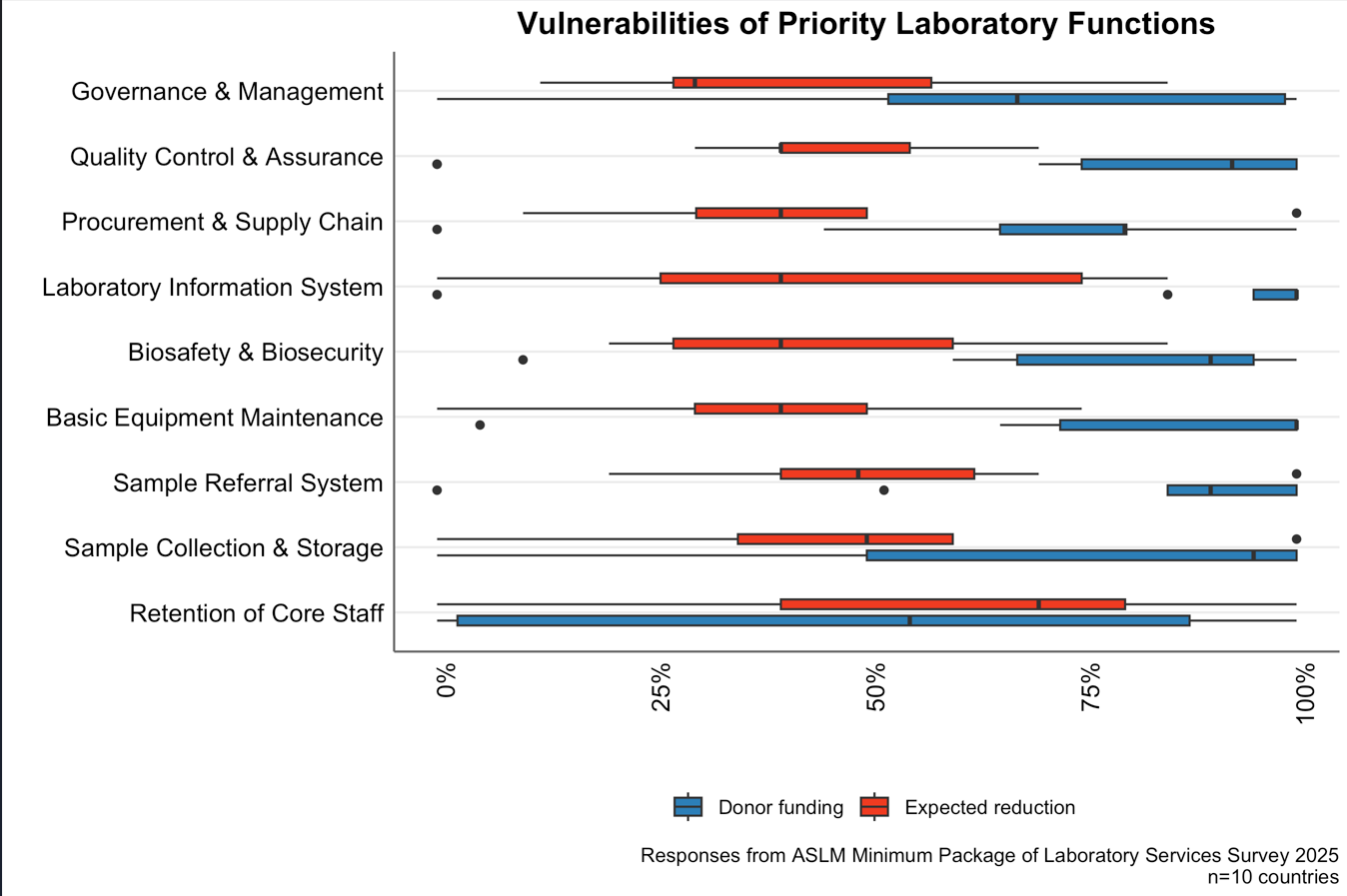
ASLM’s analysis of funding cuts to diagnostic networks showed that in early 2025, 80% of the 16 countries assessed relied on donor funding for critical laboratory services, primarily sample transport networks, equipment maintenance, and quality assurance and control. More than half did not have contingency planning, meaning these systems would collapse due to funding shocks. To help countries protect essential diagnostic services, ASLM developed the Minimum Package of Laboratory Services (MPLS) . The framework identified four priority areas: procurement of tests for priority diseases guided by the National Essential Diagnostics List (NEDL), basic equipment maintenance services, retention of core staff, and quality control and assurance. It was accompanied by a self-assessment tool to help countries evaluate the vulnerabilities in their laboratory systems. Responses from the self-assessment were received in September 2025 from 18 countries, including 10 supported by PEPFAR. Almost all countries reported that they had prioritised system elements to ensure continuity of testing services. However, among 13 that had an NEDL, only two said they were actively using it to guide prioritisation. Countries identified nine core laboratory functions as priorities aligned to the MPLS: basic equipment maintenance, biosafety and biosecurity, governance & management, laboratory information management systems, procurement & supply chain, quality control & assurance, retention of core staff, sample collection & storage, and sample referral. However, more than 90% of the estimated budget for basic equipment maintenance (~$450k), laboratory information management systems (~$700K), quality control & assurance (~$350k), and sample referral systems (~$2M) came from donor funding making them most vulnerable to funding cuts. On average, countries expected a 40% reduction in funding for these areas. This means without urgent action, some of the most essential parts of diagnostic systems could be severely weakened.
Several countries have already begun taking steps to improve sustainability. These include starting discussions on domestic resource mobilisation and using national planning processes to safeguard essential laboratory services. For example, some are adding priority tests to national health insurance schemes and universal health coverage packages, while integrating them into national cost-recovery mechanisms. Others are piloting the use of postal services and immunisation programmes to transport samples. However, while prioritisation of diagnostic core functions is underway, there is need for stronger alignment between sustainability plans, laboratory priorities, and financing decisions to avoid fragmented responses and protect the services most important to public health. Countries also need sustainable financing strategies that combine prioritisation, domestic investment, and coordinated donor support. There is potential to leverage the 5-year funding that is available through PEPFAR to strengthen diagnostic systems as domestic funding increases. Prioritising domestic resource mobilisation is urgently needed to broaden financing options, reduce donor reliance, and ensure sustainable funding for essential diagnostic services. Strategic private sector partnerships can be leveraged to improve efficiency and strengthen diagnostic services. Through the Laboratory Director’s Forum, ASLM will support countries in engaging ministries of finance and the private sector on domestic financing. ASLM is also providing technical support to strengthen the development and implementation of NEDLs as tools for prioritisation, procurement, and advocacy. In addition, a few countries have already started using the MPLS framework to develop harmonised, standardised laboratory testing guidelines.