
Nelly Rwenji & Nuru Ngailo
In March 2026 alone, three major regional trainings took place across the continent – in Accra, Dakar, and Dar es Salaam – each reflecting a different layer of the program’s growing ecosystem.
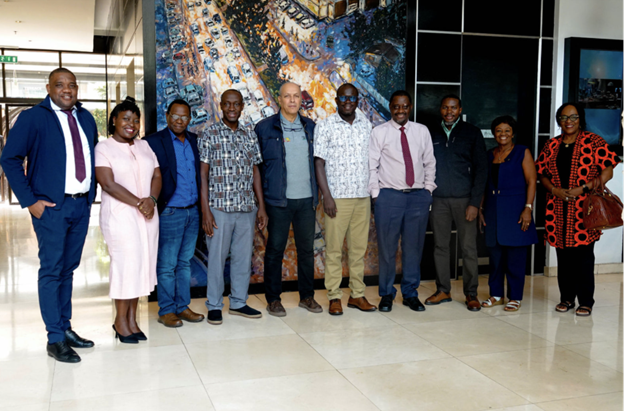
In Accra, experts from 10 countries gathered not just to learn, but to step into a new role: Africa Region Subject Matter Experts (Af-RSMEs). These are not passive trainees- they are mentors, evaluators, and future trainers responsible for sustaining the program within their countries.
As emphasized during the workshop, their role goes beyond delivering content. They are expected to guide candidates, support curriculum development, and ensure that training translates into measurable improvements in national biosafety systems.
And that expectation comes with challenges.
Low progression rates from Level 1 to Level 2 certification have highlighted a critical issue: training alone is not enough. Without strong mentorship and structured follow-through, knowledge risks remaining theoretical.
Regional learning, continental impact
Further west, in Dakar, participants from Northern Africa convened for hands-on training in biorisk and biological waste management. The training, hosted at Institut Pasteur de Dakar, demonstrated how regional centers of excellence are filling immediate gaps while longer-term infrastructure is still being established to ensure sustainability.
Rather than waiting for perfect systems, the program is adapting – leveraging existing institutions to ensure continuity and access.
Meanwhile, in Dar es Salaam, a larger and more diverse cohort of 57 experts from across Central Africa and beyond came together for multiple Level 1 courses. Here, the emphasis was on practical skills: safe laboratory practices, risk mitigation, and waste management.
But just as important as the technical content was the environment itself.
Participants learned alongside peers from different regions, exchanged experiences, and built networks that extend beyond the training room. These interactions are helping to create a shared professional identity, one that transcends national and regional boundaries.
The missing link: mentorship as a force multiplier
If there is one theme that cuts across all these engagements, it is the growing recognition that mentorship is the backbone of the program. The RTCP-BBP is not designed as a one-off training model.
It is a progression system:
- Level 1 introduces foundational competencies
- Level 2 requires practical, in-country improvement projects
- Certification depends on demonstrated impact, not attendance
To move forward, candidates must work under the guidance of certified experts, complete real-world assignments, and submit portfolios for evaluation by the Examination and Certification Committee (ECC).
This model transforms learning into practice and practice into measurable system strengthening.
It also shifts responsibility.
Trainees are no longer just recipients of knowledge; they are active contributors to improving biosafety systems within their institutions and subsequently transforming the continent.
Oversight, credibility, and the role of the ECC
While regional trainings build capacity on the ground, oversight at the continental level ensures that standards remain consistent.
The Annual Examination and Certification Committee (ECC) meeting in Addis Ababa in March 2026 brought together experts from across Africa to review progress, evaluate certification pathways, and strengthen quality assurance mechanisms. This is where the program’s credibility is safeguarded.
By reviewing portfolios, assessing candidate progression, and refining certification processes, the ECC ensures that the RTCP-BBP remains aligned with international best practices while still being rooted in Africa’s realities.
It is also where strategic questions are addressed:
- How do we improve progression rates?
- How do we ensure quality across regions?
- How do we demonstrate real impact at country level?
The answers to these questions will shape the future of the program—and, by extension, Africa’s biosafety workforce.
Beyond training: building a system
What is emerging is not just a training program, but an ecosystem.
- Regional Centres of Excellence provide infrastructure and delivery platforms
- Subject Matter Experts drive mentorship and sustainability
- Certification pathways ensure accountability and standards
- Continental oversight maintains quality and credibility
Together, these elements are creating a pipeline of professionals who are not only trained, but recognized, connected, and deployable. And that matters.
In a continent facing increasingly complex public health threats, the ability to detect, prevent, and respond to biological risks depends on more than infrastructure—it depends on people.
A shift in mindset
Perhaps the most important transformation is not technical, but cultural. As one leader noted during the Accra workshop, the focus must shift from counting how many people are trained to understanding what changes as a result. That shift from outputs to impact is what will determine the success of the RTCP-BBP.
Because ultimately, biosafety and biosecurity are not abstract concepts. They are lived realities in laboratories, hospitals, and communities.
And building a safer Africa requires more than knowledge. It requires a workforce that is skilled, supported, accountable, and impactful and a system that enables them to thrive.