
Responding to real-world needs
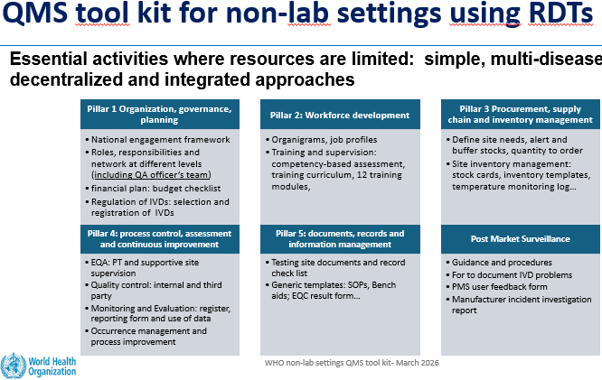
As countries expand access to testing by decentralizing services and task-shifting to trained lay providers, many testing sites face a critical gap: existing quality management systems (QMS) are too complex for non-laboratory settings. Without adapted tools, maintaining test accuracy and patient safety at community level becomes a challenge. To bridge this gap, WHO — in collaboration with external experts, implementing partners, and country representatives —developed a new QMS toolkit for multi-disease serological testing in non-laboratory settings.
The toolkit is simplified, practical, and built for real-world conditions. Rather than requiring full QMS implementation, it outlines a minimum set of activities that any site can apply to ensure reliable results. It covers HIV, syphilis, hepatitis B and C, and other rapid serological tests delivered outside traditional labs.
“The QMS tool kit does NOT replace existing tools but provide set of crucial activities to implement, in case comprehensive package cannot be implemented”_Celine Lastrucci, Consultant at WHO.
“Donors and countries need a common, realistic standard for quality where testing actually happens. This toolkit gives us that baseline — practical, scalable, and tied to impact.”. Get involved in your next cycle funding request development, reach out to your CCMs, Principal recipients and prioritize QMS and once approved, implement with fidelity. — Fatim Cham-Jallow, Team Lead, Integrated Laboratory Systems Strengthening Team, The Global Fund
Call to Action:
Bring the Toolkit to Your Country
- Ministries of Health, implementing partners, and testing programs: Download the toolkit and session slides here.
- Request technical support from WHO to adapt the minimum QMS steps to your national HIV/TB/hepatitis testing guidelines.