
Dr. Kgomotso Makhaola,
LabVoice Issue 02
Contemporary scientific practice is increasingly defined by the integration of computational analytics with high‑throughput laboratory systems. Advances in machine learning, molecular quantification, and automated quality‑management platforms are accelerating discovery and strengthening diagnostic accuracy across clinical and public‑health laboratories. In Africa, these global trends are intersecting with rapidly maturing laboratory networks, enabling more granular surveillance, improved assay performance monitoring, and evidence‑based operational decision‑making.
A central feature of this shift is the rise of data‑centric laboratory medicine. Laboratories are no longer passive endpoints for specimen processing; they are becoming analytical engines capable of detecting system‑level anomalies, validating instrument performance, and generating population‑level insights from routine diagnostic data. Viral‑load testing, antimicrobial‑resistance surveillance, and genomic sequencing are particularly benefiting from this convergence, with computational tools enabling rapid interrogation of large datasets that would be impractical to assess manually.
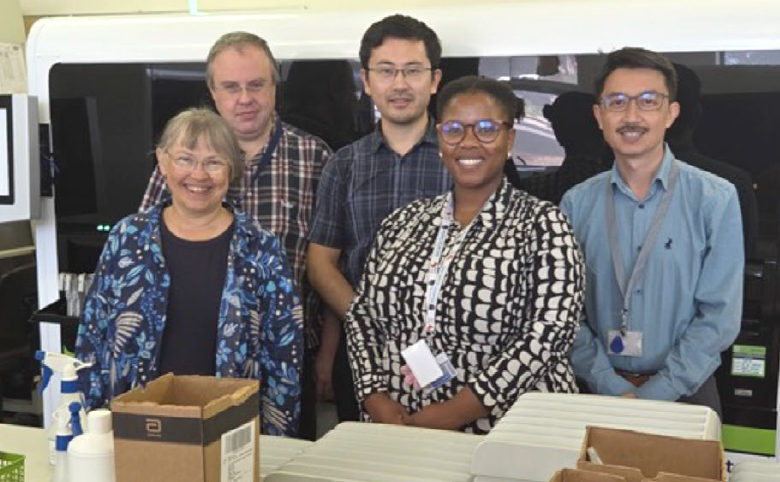
A recent African Journal of Laboratory Medicine article (https://doi.org/10.4102/ajlm.v14i1.2953 ) provides a clear demonstration of this evolution through the work of the Medical Virology team at Groote Schuur Hospital Laboratory in Cape Town, South Africa. Following a major NHLS service disruption that rerouted HIV viral‑load specimens from Limpopo to the Western Cape, GSH observed an unexpected increase in low‑level viraemia (LLV) among the diverted samples. To differentiate between analytical error, pre‑analytical compromise, and true epidemiological variation, the team deployed a Python‑based analytical pipeline to evaluate viral‑load distributions, instrument QC metrics, turnaround‑time deviations, and longitudinal patient‑level trends.
The analysis showed no evidence of contamination, reagent drift, or delayed processing effects. Instead, the LLV elevation aligned with province‑specific epidemiological patterns: Limpopo specimens demonstrated higher LLV prevalence (~20%) and lower viral suppression (~70%), compared with the Western Cape’s ~13% LLV and ~81% suppression. These findings underscore the value of computational interrogation of routine laboratory data, particularly in high‑volume virology settings where auto‑verification workflows limit real‑time human review. The GSH case illustrates how data science can be operationalized to validate laboratory integrity, contextualize unexpected result patterns, and support public‑health interpretation during system disruptions.
Across the continent, similar data‑driven approaches are emerging infectious‐disease genomics, digital ology, and bio surveillance. Laboratories are increasingly integrating statistical process‑control tools, anomaly‑detection algorithms, and automated reporting pipelines to enhance diagnostic reliability and accelerate response times. As laboratory networks continue to scale, the ability to extract actionable intelligence from routine diagnostic output will become a defining capability for public‑health resilience.