
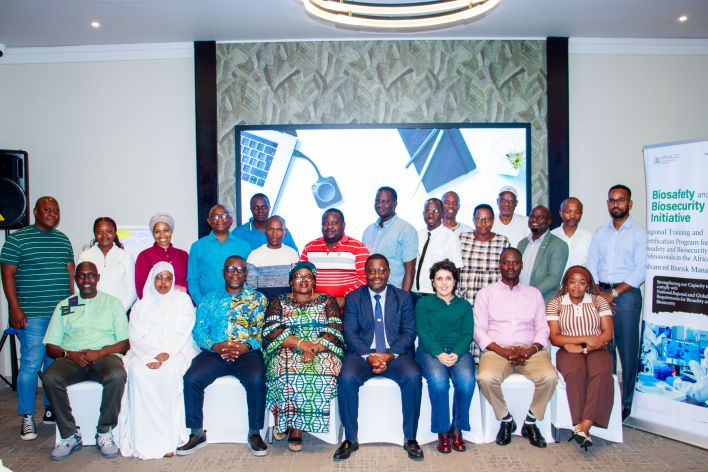
The Africa Centres for Disease Control and Prevention (Africa CDC), in partnership with the African Society for Laboratory Medicine (ASLM), has convened the Advanced BioRisk Management Course under the Regional Training and Certification Program for Biosafety and Biosecurity Professionals (RTCP-BBP) at the National Public Health Laboratories (NPHL), Regional Centre of Excellence for Biosafety and Biosecurity (RCoEBB) for Eastern Africa, in Dar es Salaam, Tanzania.
The training brings together biosafety and biosecurity professionals from Zambia, South Africa, Namibia, Eswatini, Burundi, Uganda, Kenya, and Ethiopia, with the aim of strengthening advanced competencies in biorisk management and supporting progression toward Level II certification under the RTCP-BBP framework.
Launched by Africa CDC in 2019, the Biosafety and Biosecurity Initiative was established to support African Union (AU) Member States in strengthening compliance with key international frameworks, including the International Health Regulations (IHR 2005), the Biological Weapons Convention (BWC), UNSCR 1540, and the Global Health Security Agenda (GHSA).
Despite significant global progress, assessments such as the WHO Joint External Evaluation (JEE) and the Global Health Security Index continue to highlight persistent gaps in biosafety and biosecurity capacity across the continent.
In response, Africa CDC, working with AU Member States, developed the Regional Training and Certification Program for Biosafety and Biosecurity Professionals (RTCP-BBP)—a standardized, regionally endorsed framework designed to build sustainable professional capacity across four core specialisations:
- Biorisk Management (BRM)
- Biological Waste Management (BWM)
- Biocontainment Engineering (high-risk facility management)
- Biological Safety Cabinet (BSC) certification, installation and maintenance
The program is structured across three certification levels (Level I–III), with progression from Level I to Level II requiring completion of improvement projects, practical exercises, and competency assessments within participants’ home countries.
The Advanced BioRisk Management Course is specifically designed for Level I certified professionals, providing advanced, hands-on training through guided exercises, expert mentorship, and structured review of improvement projects. It also supports participants admitted through alternative pathways who meet Level I proficiency requirements.
Participants are engaging in advanced learning modules covering risk analysis, mitigation strategy design, application of international standards, risk communication, leadership in high-risk environments, and implementation of national improvement projects.
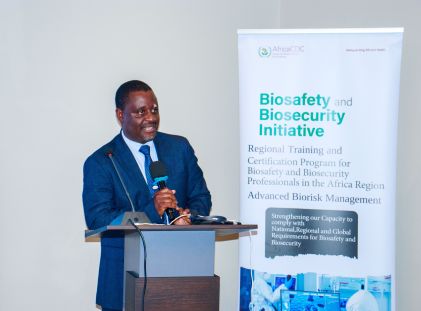
Speaking during the official opening ceremony, Dr. Talkmore Maruta, Director of Programs at ASLM, expressed appreciation to the Government of the United Republic of Tanzania and the Ministry of Health for hosting the Regional Centre of Excellence, describing it as a critical platform for strengthening Africa’s biosafety and biosecurity workforce.
He noted that since its establishment, the Centre has trained more than 230 professionals from East, Central, West, and Southern Africa across the four RTCP-BBP specialisation areas, reflecting Tanzania’s leadership in regional health security capacity building.
Dr. Maruta emphasized that the Advanced BioRisk Management Course responds directly to persistent gaps in certification progression and mentorship systems across the continent.
He further highlighted that despite progress under the program, only approximately 500 professionals have been trained continent-wide, with certification pass rates remaining below 50 percent, underscoring the need for strengthened practical training, mentorship, and competency development mechanisms.
The RTCP-BBP continues to evolve in response to emerging global health security challenges. Africa CDC has expanded the program to include new areas such as Cybersecurity and Artificial Intelligence in Biosafety and Biosecurity, reflecting the increasing convergence between biological sciences and digital technologies.
Dr. Maruta noted that participants trained under the program are expected to serve not only as certified professionals, but also as national champions and mentors, contributing to sustainable biosafety and biosecurity systems within their respective countries.
The Advanced BioRisk Management Course plays a critical role in strengthening Africa’s ability to prevent, detect, and respond to biological threats. Through practical training, mentorship, and structured competency development, the program aims to:
- Strengthen national biosafety and biosecurity systems
- Improve laboratory safety and operational efficiency
- Reduce dependence on external technical service providers
- Enhance outbreak preparedness and response capacity
- Support sustainable laboratory infrastructure across AU Member States
As Africa CDC continues to expand its Regional Training and Certification Program through additional Centres of Excellence, including the forthcoming North Africa Centre of Excellence scheduled for 2026, initiatives such as the Advanced BioRisk Management Course remain central to building a resilient, skilled, and future-ready biosafety and biosecurity workforce across Africa.